
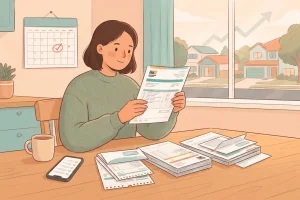
Picture a busy emergency department on a Friday night. Nobody gets seen in the order they walked through the door. A triage nurse looks at everyone, decides who needs attention now and who can safely wait an hour, and the whole room runs better for it. Your bills deserve that same calm assessment — and this month, more than most.
On 3 November 2026 the Reserve Bank of Australia lifted the cash rate target by 25 basis points to 4.85%, effective the next day — its fifth rate rise of 2026. For mortgage holders that means a bigger repayment; for almost everyone it means a tighter month. The squeeze is already showing. An AMP survey of 1,012 Australians, conducted by Dynata and published on 4 November, found 17% — about one in six — would have less than a week's cover for essentials if their income stopped, and 32% name everyday bills and expenses as their biggest financial concern. Meanwhile a Finder survey of 1,006 Australians found 23% had missed or delayed at least one bill in the past 12 months to cover their rent or mortgage, roughly 2.3 million households.
When housing costs jump, something else always gives. The only question is whether you choose what gives, or whether it gets chosen for you by whichever bill happens to land on the wrong day. This post is about choosing — no doom, just a practical way to stay in charge.
#Why This Hike Lands Harder Than the Number Suggests
Twenty-five basis points sounds small on its own. What makes this one sting is the company it keeps. The board was split 6-3 on the decision, and the Reserve Bank said inflation remains elevated and is broadly based — in other words, it isn't one category running hot, it's most of the shopping basket (RBA media release, 3 November 2026).
And it has been a long year of them. The cash rate went up in February, March, May, September and now November (RBA cash rate history). Each rise is a small turn of the screw; five in ten months is the kind of slow pressure you only notice when the lid won't close.
The Australian Bureau of Statistics shows where that pressure lands at home. Its Employee Selected Living Cost Index rose 5.1% in the year to September 2026, with insurance and financial services the biggest contributor. Separately, mortgage interest charges rose 5.7% in the September quarter alone (ABS, released 4 November 2026). That was all before this latest hike.
For people with a home loan, the margin is wearing thin. Roy Morgan figures cited by Deloitte Access Economics put 31.8% of mortgage holders — about 1.75 million households — at risk of mortgage stress in September 2026, a number expected to rise to about 1.82 million after the November hike (Deloitte Access Economics, November 2026).
#When Housing Costs Rise, Other Bills Get Squeezed by Accident
Here's the part I find most telling. When the rent or mortgage takes a bigger bite, the bills that get pushed aside are rarely chosen carefully — they're simply the ones that fall due at the wrong moment. In Finder's research, the bills most often delayed to cover housing were electricity/gas (8%), car insurance and credit cards (6% each), and home internet, buy now pay later and home insurance (5% each) (Finder, October 2026).
None of those are frivolous. Skipping insurance can leave you uncovered right when you can least afford a surprise, and a missed payment on a card or BNPL plan usually brings a fee — I've written about the real cost of late payment fees separately. Every one of those outcomes is easier to avoid when you can see it coming.
The squeeze isn't spread evenly, either. In AMP's research, a third of single parents (33%) said they'd have less than a week's cover for essentials if their income stopped (AMP, 4 November 2026). If that's you, even a few days of buffer changes the whole picture.
"Keeping up with regular bills can leave very little room for a change in circumstances."
Sean O'Malley, Group Executive, AMP Bank (4 November 2026)
That's the case for triage in one sentence: when there's little room, you can't let chance decide the order your bills get paid.
#How to Triage Your Bills on Purpose
#1. Line up every bill against pay day
Write down every bill — rent or mortgage, energy, insurance, phone, internet, subscriptions, BNPL instalments — with its amount and due date, then put your pay days beside them. Most of the stress hides in the timing, not the total: a fortnightly pay and a monthly bill drift in and out of step, so one fortnight carries three big bills while the next carries almost none.
BillOut makes that list painless. As a bill tracker, it takes each bill once, whatever schedule it keeps — fortnightly, quarterly or something stranger — and its calendar view shows exactly where they bunch up. Add your pay as well and you'll see what's left on pay day once the bills have taken their share.
#2. Decide what can move — and what can't
For most households, housing, energy and whatever keeps you insured and able to get to work sit in the top tier. For everything else, ask: can this date shift? Can this plan pause, shrink or be cancelled? Some bills have more give than you'd expect; the ones that don't are the ones to protect first. If you want a rough sense of the room you have each period, BillOut's income split view (needs, wants and savings, 50/30/20 by default) shows what's left to work with.
#3. Call before it's overdue, not after
This is the step that changes outcomes most, and the one people put off longest because the call feels awkward. Many energy retailers, telcos, insurers and lenders have a hardship team or process, and asking before a bill tips into overdue tends to open more doors: an extension, a payment plan, a temporary arrangement. Ask what's available, note who you spoke to, and put any new dates straight into your list.
If it all feels too big to untangle alone, the National Debt Helpline (1800 007 007) is free and can help you work through your options. BillOut won't make that call for you — but it can make sure you remember to make it while there's still time.
#4. Set reminders early enough to act
A reminder on the due date mostly tells you you're out of options. A reminder a week or two ahead gives you time to move money, ring a provider or rearrange the queue. In BillOut, a bill reminder can go off as early as three weeks before the due date, so for the bills you flagged as tight, choose a long lead time — that's your window for the phone call in step 3. It's the same habit I recommend for setting a reminder before each BNPL payment, where instalments have a way of stacking up.
And if something does slip, BillOut marks unpaid bills past their due date as overdue, and the app-icon badge can count your unpaid bills within a range you choose plus anything overdue — so a missed payment doesn't sit there quietly out of sight.
Download BillOut — Bill Reminder App
You decide which bill comes first, not pay day


#Choose the Order, Don't Inherit It
Rate decisions are out of your hands. The order your bills get paid in isn't. Triage won't make the pressure disappear, but it turns a vague, sinking feeling into a short list of decisions — this one first, that one after pay day, this provider gets a call on Thursday.
So this week, take twenty minutes and run the four steps, so you never miss a bill simply because it arrived at a bad moment. It won't shrink the mortgage, but it will mean that whatever gives this month gives because you decided — not because a bill happened to land on the wrong Tuesday.
Important Notice
The opinions expressed in this article are for general informational purposes only and are not intended to provide specific advice or recommendations for any individual or on any specific security or investment product and should not be relied on in place of professional advice. It is only intended to provide education about the financial industry.
BillOut is not responsible for the content of any site owned by a third party that may be linked to this article and no warranty is made by us concerning the suitability, accuracy or timeliness of the content of any site that may be linked to this article. BillOut disclaims all liability (except for any liability which by law cannot be excluded) for any error, inaccuracy, or omission from the information contained in this article and any loss or damage suffered by any person directly or indirectly through relying on this information.